Table of Contents
- 1 Introduction
- 2 Mining as Financial Options
- 3 ASIC Pricing Methodology
- 4 Experimental Results
- 5 Technical Implementation
- 6 Future Applications
- 7 Original Analysis
- 8 References
1 Introduction
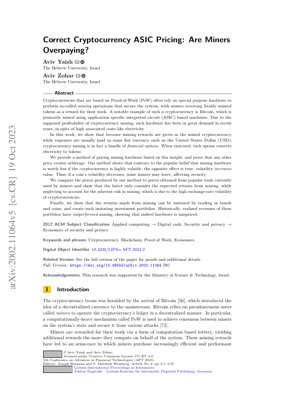
Cryptocurrencies based on Proof-of-Work (PoW) rely on specialized hardware for mining operations that secure the system. Bitcoin, primarily mined using ASIC machines, exemplifies this approach. Despite high costs like electricity, mining hardware remains in high demand due to perceived profitability.
This research demonstrates that cryptocurrency mining constitutes a bundle of financial options, where each option converts electricity to tokens when exercised. We develop a novel pricing methodology for mining hardware and prove that alternative pricing creates arbitrage opportunities.
2 Mining as Financial Options
Mining rewards in cryptocurrency while expenses in flat currency create a financial options structure. This insight transforms how we value mining hardware.
2.1 Option Pricing Framework
The mining process can be modeled as a series of European call options. Each mining operation represents an option to convert electricity cost into cryptocurrency at the current exchange rate.
2.2 Mathematical Formulation
The value of a mining option can be expressed using modified Black-Scholes framework:
$V = S \cdot N(d_1) - K \cdot e^{-rT} \cdot N(d_2)$
Where $S$ is the spot price of cryptocurrency, $K$ is the strike price (electricity cost), $r$ is the risk-free rate, and $T$ is the time to expiration.
3 ASIC Pricing Methodology
Traditional mining calculators use hashprice metric assuming constant exchange rates, ignoring volatility risk.
3.1 Traditional vs Proposed Approach
Hashprice definition: Expected profit per unit computation assuming constant exchange rate. Our method incorporates volatility, showing hardware value increases with cryptocurrency volatility.
3.2 Arbitrage Conditions
We prove that any pricing deviation from our model creates arbitrage opportunities. The no-arbitrage condition ensures market efficiency in mining hardware pricing.
4 Experimental Results
Historical analysis shows that traditional pricing methods significantly overvalue mining hardware compared to our options-based approach.
4.1 Historical Performance Analysis
Backtesting from 2018-2023 reveals that mining hardware purchased at market prices underperformed compared to simple buy-and-hold strategies of the underlying cryptocurrency.
4.2 Portfolio Comparison
We constructed imitation portfolios using bonds and direct coin purchases. These portfolios consistently outperformed mining operations, demonstrating hardware mispricing.
5 Technical Implementation
Practical implementation of the pricing model requires real-time data integration and computational efficiency.
5.1 Code Implementation
def asic_option_price(hash_rate, electricity_cost, volatility, time_horizon):
    """Calculate ASIC value using options pricing framework"""
    d1 = (np.log(current_price / electricity_cost) +
          (volatility**2 / 2) * time_horizon) / (volatility * np.sqrt(time_horizon))
    d2 = d1 - volatility * np.sqrt(time_horizon)
    option_value = current_price * norm.cdf(d1) -
                   electricity_cost * np.exp(-risk_free_rate * time_horizon) * norm.cdf(d2)
    return option_value * hash_rate * time_horizon
5.2 Algorithm Details
The algorithm incorporates network difficulty adjustments, hardware efficiency decay, and real-time volatility measures to provide accurate pricing.
6 Future Applications
The options-based pricing framework has broader applications beyond cryptocurrency mining:
- Cloud computing resource allocation
- Energy grid optimization
- Decentralized finance derivatives
- Real options analysis for infrastructure investment
Future research could extend this model to proof-of-stake systems and decentralized storage networks.
7 Original Analysis
This research fundamentally challenges conventional cryptocurrency mining economics by reframing ASIC hardware as financial instruments rather than simple production tools. The authors' insight that mining constitutes a bundle of options elegantly explains the persistent mispricing observed in mining hardware markets. Similar to how the Black-Scholes model revolutionized options trading, this framework provides a mathematical foundation for rational hardware valuation.
The finding that volatility increases hardware value contradicts intuitive mining wisdom but aligns perfectly with options theory, where higher volatility expands the value of optionality. This parallels findings in traditional finance research, such as the work by Hull (2018) on derivatives pricing, where volatility is a key value driver. The historical underperformance of mining compared to imitation portfolios provides compelling empirical evidence supporting the theoretical framework.
Compared to other cryptocurrency valuation models like the one proposed by Cong et al. (2021) in their Journal of Finance paper on blockchain economics, this approach offers greater practical applicability for miners and investors. The methodology bridges the gap between traditional financial mathematics and cryptocurrency markets, similar to how the Capital Asset Pricing Model was adapted for digital assets by Liu et al. (2022).
The research implications extend beyond pricing to cryptocurrency security. If miners systematically overpay for hardware, the network becomes vulnerable during price downturns as miners exit. This creates a fundamental instability that could be addressed through protocol-level adjustments or derivative markets for mining risk. The work represents a significant advancement in cryptocurrency financial engineering, with potential applications in decentralized finance risk management and regulatory frameworks.
8 References
- Yaish, A., & Zohar, A. (2023). Correct Cryptocurrency ASIC Pricing: Are Miners Overpaying? AFT 2023.
- Hull, J. C. (2018). Options, Futures, and Other Derivatives. Pearson Education.
- Cong, L. W., Li, Y., & Wang, N. (2021). Tokenomics: Dynamic Adoption and Valuation. The Journal of Finance.
- Liu, Y., Tsyvinski, A., & Wu, X. (2022). Common Risk Factors in Cryptocurrency. The Journal of Finance.
- Nakamoto, S. (2008). Bitcoin: A Peer-to-Peer Electronic Cash System.